
The Gray Zone


Russia has a tradition of engaging in war at a level below a kinetic response. It is known as the Gerasimov Doctrine, but it goes back much longer. During the Cold War, they did this often, testing boundaries using spies, active measures, and deep penetration of enemy societies. This has been brought to the modern period, and Western governments seem to have forgotten some of the lessons of the Cold War. So today I woke up to this, which I realize most people will ignore. However, this should not be ignored. It is a test, and it is reconnaissance establishing response in the West, both military and social:
Two unidentified drones were spotted flying over a Bundeswehr military base in Mechernich, Germany, at around 10:00 p.m. on Thursday, - DIE ZEIT
Russia likely has people in the West who can go active on a moment's notice. Remember how many Russians left in 2022? Most legitimately left because they wanted to avoid the draft or the war. They disagreed with the war. But the reality is that in that population flow, Russia inserted spies and other people who could help rebuild their networks in the West. This is what Russia has done for a long time. This is not a new pattern, even if we seem to act as if it were. It is not new, and a minimum level of suspicion must be maintained with migrants, because a few did not leave Russia for the reasons stated.
And there are not many of them. It sucks that we have to keep a level of suspicion toward mostly innocent people. And if you know Russian history, you know this has been the case for many generations. Alas, for the sins of a few, we need to keep our eyes on all.
Russia also uses locals who, for ideological or financial reasons, join the Russian cause. So drone operators may very well be German. So take that into account. And we must act as if we are on the leading edge of a war. Then we have this warning:
Russia could attack NATO using Ukrainian drones.
The Lithuanian Minister of Defense, Arvydas Anušauskas, stated that Moscow is considering the possibility of launching unconventional attacks on critical infrastructure in the Baltic region.
“We have information that Russia is considering the possibility of carrying out unconventional kinetic attacks against critical infrastructure in the Baltic region. It is quite likely that Russia could use drones of Ukrainian manufacture for this purpose,” he said.
According to Lithuanian authorities, Russia has not yet made a final decision on whether to carry out such an operation. Nevertheless, Lithuania has already increased security at a number of critical infrastructure facilities.
And this is not the only warning. Per the Telegraph, US Intelligence expects a Russian test or attack soon. All I am going to say is welcome to the party, boys and girls. We have been seeing signs of this for months, and it is just getting worse. So now, US Intelligence is there. Never mind that the President of the United States won’t know how to react to this crisis. In fact, I expect him not to react because he does not want to anger Vladimir Putin.
However, the Special Military Operation is no longer as popular as it once was. Partially, the war has come home in ways that every day Russians, not just military families, can deny at this point:
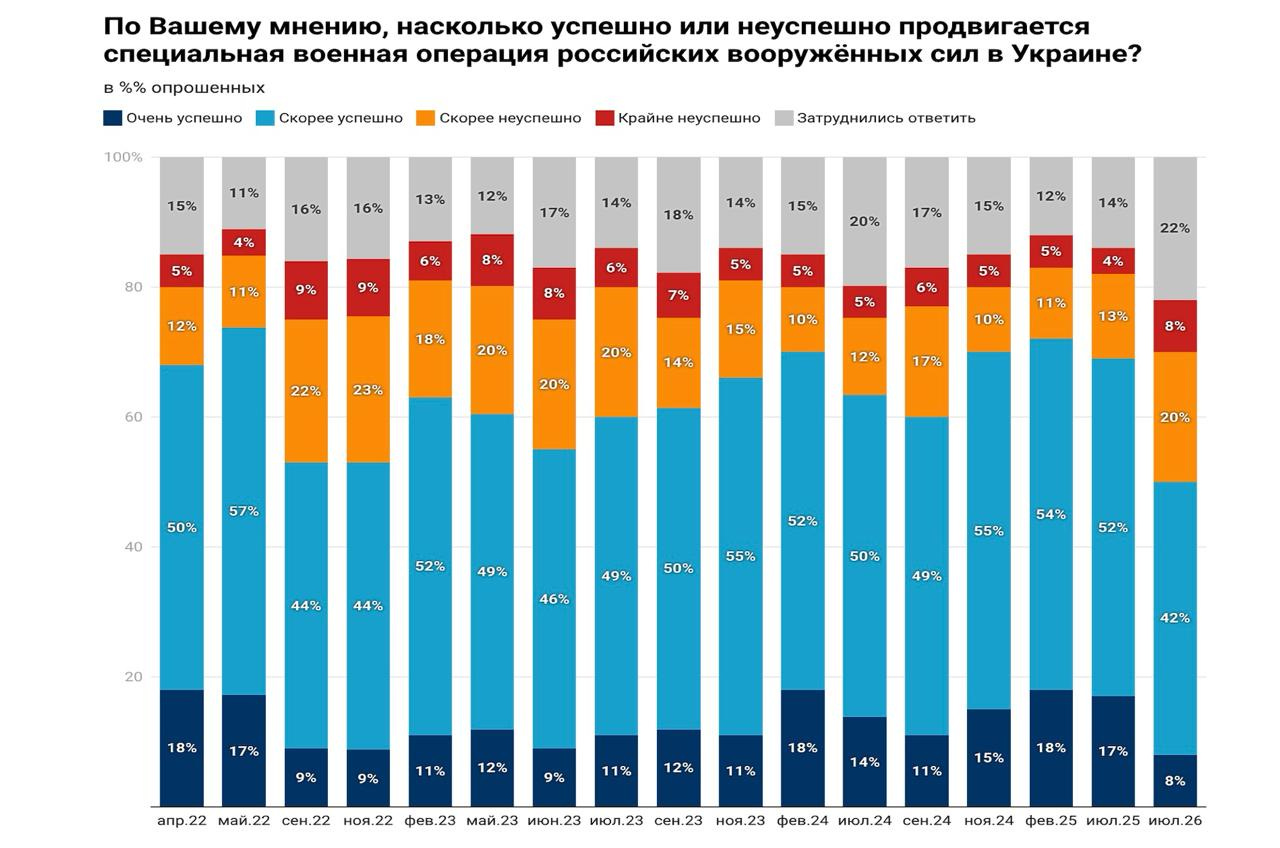
For the first time since the start of the war, half of Russians no longer consider the invasion of Ukraine to be “successful.”
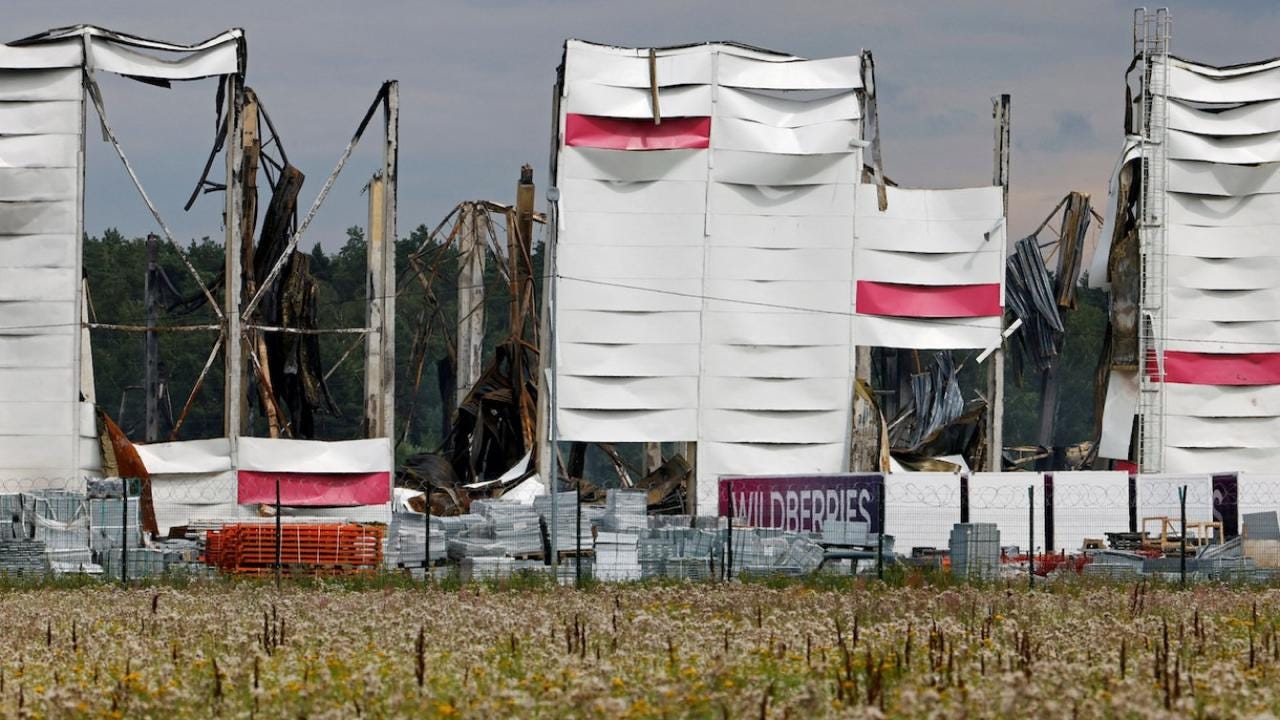
The Ukrainian campaign of long-range strikes, the fuel crisis, the burning Wildberries warehouses, and the growing rumors of an upcoming mobilization in the fall have all contributed to a decline in support for the war within Russian society. For the first time since the invasion of Ukraine, half of Russian citizens do not consider Vladimir Putin’s “special military operation” to be “successful,” according to a survey by the Levada Center.
In July 2026, only 8% of those surveyed described Putin’s “special military operation” as “very successful” – a record low in over four years of research. The same percentage (8%) described it as “extremely unsuccessful,” 20% as “rather unsuccessful,” and 22% “refused to answer.”
At the same time, the proportion of respondents who were not afraid to tell sociologists that they “rather do not support” or “definitely do not support” the actions of the Russian Armed Forces in Ukraine reached 21%, which is also a record since the beginning of the war. The proportion of those who “definitely” support the war has fallen to 34%, although in the first month of the invasion, it exceeded half.
A series of Ukrainian strikes, targeting oil refineries and then the logistics hubs of Russia’s largest online marketplace, have brought the war into the civilian economy, posing questions that the authorities are not ready to answer, notes Tatiana Stanovaya, founder of R.Politik.
The main electoral motive that prompted people to vote en masse for Putin a quarter of a century ago was the desire for security, a peaceful life, free from explosions and killings, where homes do not collapse and cities do not burn, notes political scientist Abbas Gallyamov.
But Putin, who promised security, has instead led to its complete destruction, Gallyamov observes: “In today’s Russia, no one can feel safe – neither a general going to a restaurant to celebrate his anniversary; nor a vacationer finally relaxing on the beach in Gelendzhik; nor a resident of the Moscow region peacefully sleeping in their bed during a nighttime drone attack; nor an employee of a Wildberries warehouse.”
That it takes people noticing from where they sit on the couch is true. However, better late than never, I suppose. And given that the Levada Center is public polling, saying what you think may have some possible bad consequences. This matters. So Putin promised people would stay there, don’t say a thing, and you will live your life... but now you can’t get pet food at Wildberries.
The sense of safety has been shattered, and it does not matter what society; once safety is shattered, the social contract begins to change. And given that Russians, for the most part, never showed an ounce of empathy to Ukrainians, well, there is nobody who feels that sorry for Russians. Some people's hobby is just watching Russians complain on Telegram. I just note this for the sociological meaning: Russia is starting to reach a reckoning.
However, given that Russians are crying over Wildberries, while still celebrating attacks on Kyiv, no wonder people really have no empathy. There are Russians you can have empathy for; for the most part, though, they no longer live in Russia. Then there is this economic reality about the strikes:
“A wave of bankruptcies is coming.” The Kremlin has no money to save Wildberries sellers.
Russia does not have enough funds to save the sellers affected by the Wildberries marketplace, a source close to the Kremlin told Reuters.
According to the source, what happened to the marketplace, which controls half of the e-commerce market in the country, is “a serious blow to the economy.” “There will be a wave of bankruptcies. No one has the money to support the sellers. We are talking about hundreds of billions of rubles,” the source said.
At least 20 of Wildberries’ logistics hubs have been attacked by drones, and some have been completely destroyed. As a result, the company has lost 1.18 million square meters of warehouse space, or about a fifth of its total capacity, according to Reuters calculations. Tens of thousands of entrepreneurs have been affected, losing their goods and the ability to sell them.
Russian authorities are discussing a support package for sellers, which, however, does not include direct payments to those affected. Options being considered include loan holidays, preferential loans, and tax breaks.
The problem is also that a significant portion of the sellers on Wildberries are individual entrepreneurs (IEs). And according to the law, they are liable for their debts with their assets. In other words, those who have lost goods through no fault of their own, and who have loans, may lose all or most of their assets. The Chamber of Commerce and Industry has proposed to the government to change the bankruptcy procedure to prevent such a situation, sources at “Vedomosti” told.
Russian authorities know that this is a bomb that could go off. Because this is no longer the hero of the SVO, preferably still missing, likely dead in Ukraine. This is Olga down the street, and Ivan, who relies on this business model to keep the lights on. These are the people who, in many cases, supported United Russia, but the social contract is gone. So, lack of bread and electricity, prepared for a long war; no longer SMO... Russians are ever so slowly waking up to this reality.
And if Russia does test NATO, and NATO responds, there will be a need for a mass mobilization. In some ways, changing the war from a limited special military operation that was supposed to last three days, to a civilizational war (for real) could allow Russian leaders to completely close down the country.
That they do not have the logistics, uniforms, small arms, or what have you to equip the forcibly mobilized troops is another story. Russia squirrels everything away. So expect to see more older Soviet kits as this continues down that path. And we have already seen quite a bit of late soviet kit. And who can forget the Mosin–Nagant earlier in the war with Donbas units? And to be fair, that is a fantastic sniper rifle. It is also a good hunting rifle.
In the Great Patriotic War, part of the Russian mythology, partly based on reality, units were quickly assembled and thrown into the meat grinder. Training was sketchy at best. Because that training was done on the front lines by those who survived to the next battle. So if Russia tests NATO and gets a surprise because it does not expect the West to react, it will be grand. And we are walking every so closer to reacting:
Polish Foreign Ministry calls for discussion on possibility of intercepting Russian missiles over Ukraine
Polish Foreign Minister Radosław Sikorski has called for a discussion on the possibility of intercepting Russian missiles while they are still over Ukrainian territory, rather than waiting for them to potentially enter Polish airspace. According to PAP, the diplomat stated that this issue “requires a serious discussion” and should not become “a hostage to partisan rivalry” against the backdrop of internal political disagreements in Poland. The reason for his statement was the recent remarks by former Prime Minister Mateusz Morawiecki (the “Development Plus” party), who spoke out against the transfer of another batch of missiles to Ukraine for Patriot systems, which Kyiv needs to destroy Russian ballistic missiles, and suggested the possibility of disbanding the Polish Armaments Group (PGZ).
Sikorski emphasized that Kyiv has been subjected to massive strikes by Russian ballistic missiles for several days in a row, “against which there is currently no defense,” and the number of civilian casualties continues to rise. “Can we be sure that it would be better to shoot down these Russian missiles over Ukraine, rather than, perhaps, later over Poland? This is a topic for a very serious discussion that should not become a hostage to partisan rivalry,” said the Polish Foreign Minister.
If Poland does this, we are quickly moving outside the gray zone. Realize, a missile “strayed” into Polish territory, so this is becoming more real by the day. That is, war is coming further beyond Ukraine. As I wrote the other day, armies can train for war. They can equip themselves for war, but no soldier is truly ready for war. War is not the fantasy heroic place you and I see in the movies. War is hell, which is one reason European leaders have been trying to avoid it. The last European war left most of the continent in ruins, and for obvious reasons, they do not want to repeat this experience.
Would this be Article 5? No. Because Poland would be extending air cover, not because she was attacked. I could argue ten ways to Sunday that it should, but the way this is written, it does not. So it also makes things more shady.
