
Ukrainian Attacks Continue in the Russian Federation

Ukrainian Attacks Continue in the Russian Federation
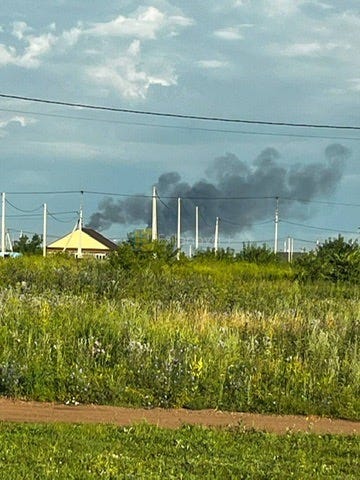
This morning, we woke up to this news, which is no surprise at this point. Russia no longer has a deep rear, and this is the reality because Ukraine has a free hand in the Russian rear. In other words, Russian air defense seems nonexistent. So this is the latest example. And I hope people realize how important this is. Russia is quickly running out of plants capable of processing that oil into gas, diesel, and other products. Here are posts one and two:
Gazprom Neftekhim Salavat is on fire in Bashkortostan after an attack by the Defense Forces.
This is one of the largest oil refining complexes in the Russian Federation with a capacity of 10 million tons of raw materials per year.
Gazprom Neftekhim Salavat refinery 🔥
According to preliminary data, the strikes hit:
• AVT-6 (primary oil distillation unit)
• Shop 20 (high-density polyethylene production).
https://t.me/MAKS23_NAFO/109669
And I admit, I usually do not cover the tit-for-tat, but this is the list of Ukrainian attacks. This is quite extensive, and it is an example of what is happening every night:
Chronicles of the night. UAV attack
💥Donetsk. Ammo warehouse hit
💥Krasnodar Krai. Afipsky refinery.
💥Salavat, Bashkortostan. Gazprom Neftekhim Salavat Refinery Hit
💥Kerch. Kerch Substation Hit (220/110/10 kV Substation)
💥Berdyansk. Hit in the area of the Azovkabel plant.
💥Melitopol. Power infrastructure hit. As a result, a significant part of Zaporizhzhia Oblast is without power
🔥Kherson Oblast. After a night attack on power infrastructure - a complete blackout
🔥Sevastopol. After a night attack, power supply went out.
💥Gelendzhik, Krasnodar Krai. A fire is recorded after the attack. Details need to be clarified.
⛴ 10 ships hit by SBS in the Sea of Azov
This matters because Russia is losing the ability to produce the energy sources it needs. This is now translating into an even deeper crisis. And let’s face it, some of the reports would not be unusual in a similar crisis anywhere else in the world. I mean, fights, sure:
Fights and gunfights break out at Russian gas stations
In a desperate attempt to obtain even a small amount of fuel, Russians are willing to do anything:
👉 In Penza, drivers fought each other for a spot in line using baseball bats.
👉 In Perm, a gunfight broke out.
👉 In Novorossiysk, a fuel truck was hijacked.
👉 Across the country, people are siphoning gasoline from parked cars at night.
😱 In Rostov-on-Don, gas stations are now patrolled by Cossacks, in the Tomsk region – by military personnel, and in other regions – by officials, police, and volunteers.
Countries under the kind of pressure that Russia is under will lead to social tensions and social breaks. And this is exactly what we are watching. And at this point, we also have a serious problem as regions are starting to close off from each other. This matters because it has happened before:
Regions are being isolated. When will we see our own currencies?
What has the fuel crisis already led to? Fueling based on vehicle registration numbers and QR codes, priority for local residents, restrictions on fuel exports. This is how life is for more than 40 regions of Russia today.
However, this is nothing new for our country. In the 1990s, in addition to coupons, makeshift customs posts operated on administrative borders, barter exchanges existed between regions, and even the first ersatz currencies appeared – “Nemtsov rubles,” social checks in Tatarstan, and the “Ural franc.”
Today, the process is following a similar path – only it started not with food, but with fuel. But the context is different: governors are no longer elected officials, but Kremlin appointees, who can be easily removed and even easier appointed.
However, there are things that have begun to slip out of the control of the capital: the growing deficit of regional budgets, and Ukrainian Armed Forces strikes deep into Russia. Sooner or later, the heads of the regions will face a choice between a popular uprising and dissatisfaction with the Center.
Can we expect a “parade of sovereignties” from the current governors appointed by the Kremlin? Specifically for “NeMoskva,” Tatyana Rybakova investigated.
Do you want to thank “NeMoskva” for its work? Leave us paid reactions in the form of stars!
And it was not just the 1990s. Though that was the worst time for this, outside of the Russian Revolution of 1917. However, I think that the tensions will grow. That ice flow is starting to accelerate. And as all ice flows, it remains barely noticeable until it fully breaks.
So here is another noise signal of how badly this crisis is affecting Russia. At this point, the front lines. And trust me, the Russian Army was already having logistics problems before this:
OSINT researcher Chris O’Wicki notes widespread complaints from Russian volunteers regarding the fuel situation.
Due to the inability to refuel, these volunteer groups have significantly reduced the delivery of supplies to Russian military personnel.
These groups do not receive priority fuel supplies like the military, they cannot fill up containers in advance, and there is already virtually no fuel available for civilians in the occupied territories.
As a result, some Russian volunteers have already started accepting donations of gasoline in canisters.
This is reminiscent of 1917. One reason for the revolt was the lack of bread and ammunition at the front lines. And that was a moment for Imperial Russia. We may be heading to a similar moment. And it seems we are heading to a real disaster if you are one Vladimir Putin. And I want to first share this video regarding Crimea:
