

There is an old saying that goes something like this. Amateurs talk tactics; professionals study logistics. It’s attributed to General Omar Bradley, and it talks about a reality of war. You can have the grandest of strategic plans. Without the fuel, water, food, ammunition, and other essentials, your plan will ultimately fail.
Another military strategist put it this way: Napoleon Bonaparte: An army marches on its stomach.
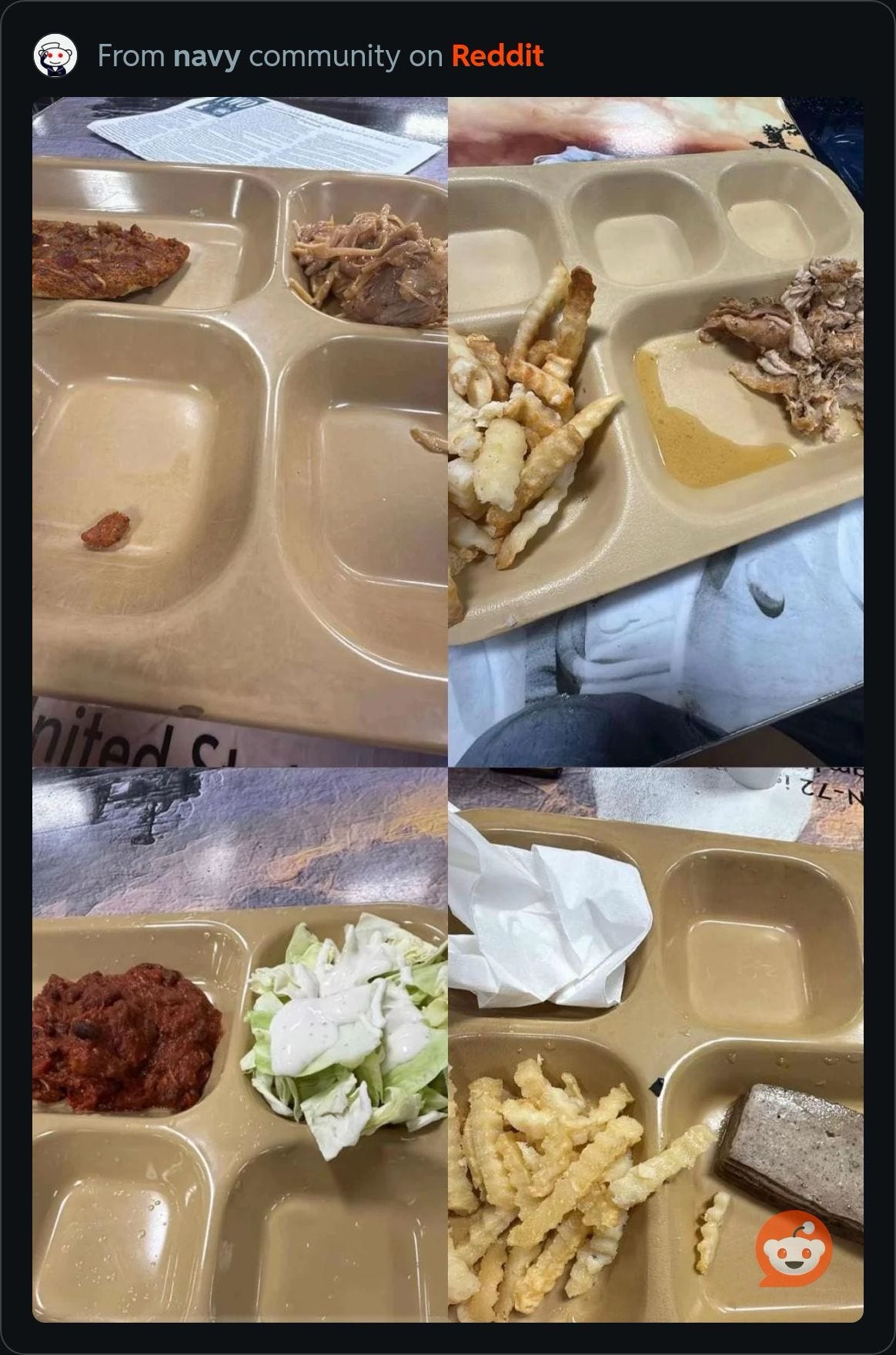
So what about Bradley and the US military? He belonged to a military machine that brought logistics down to the finer points of life. US troops had access to warm food even relatively close to the line. Troops complained about C-Rats and K-Rats, because griping about food is always a thing in any military. But compared to either allied counterparts or enemy armies, US troops were well fed, even if it wasn't tasty enough. And yes, the Navy produced ice cream in the Pacific throughout the war. Think about this for a second: the Navy had dedicated barges whose job was to produce ice cream, which requires milk, fruit or other flavors, sugar, and salt. Now look at USN sailors on the Lincoln eating midrats made of cereal, but no milk, because they hadn't seen milk in over three months.
To be fair, replenishment at sea rarely includes milk, shelf-stable or otherwise. The navy usually gets fresh stores at port. Those port calls also give crews a chance to blow off steam. But they could have brought in powdered milk. And yes, they do make their own water. However, even shower water is a problem.
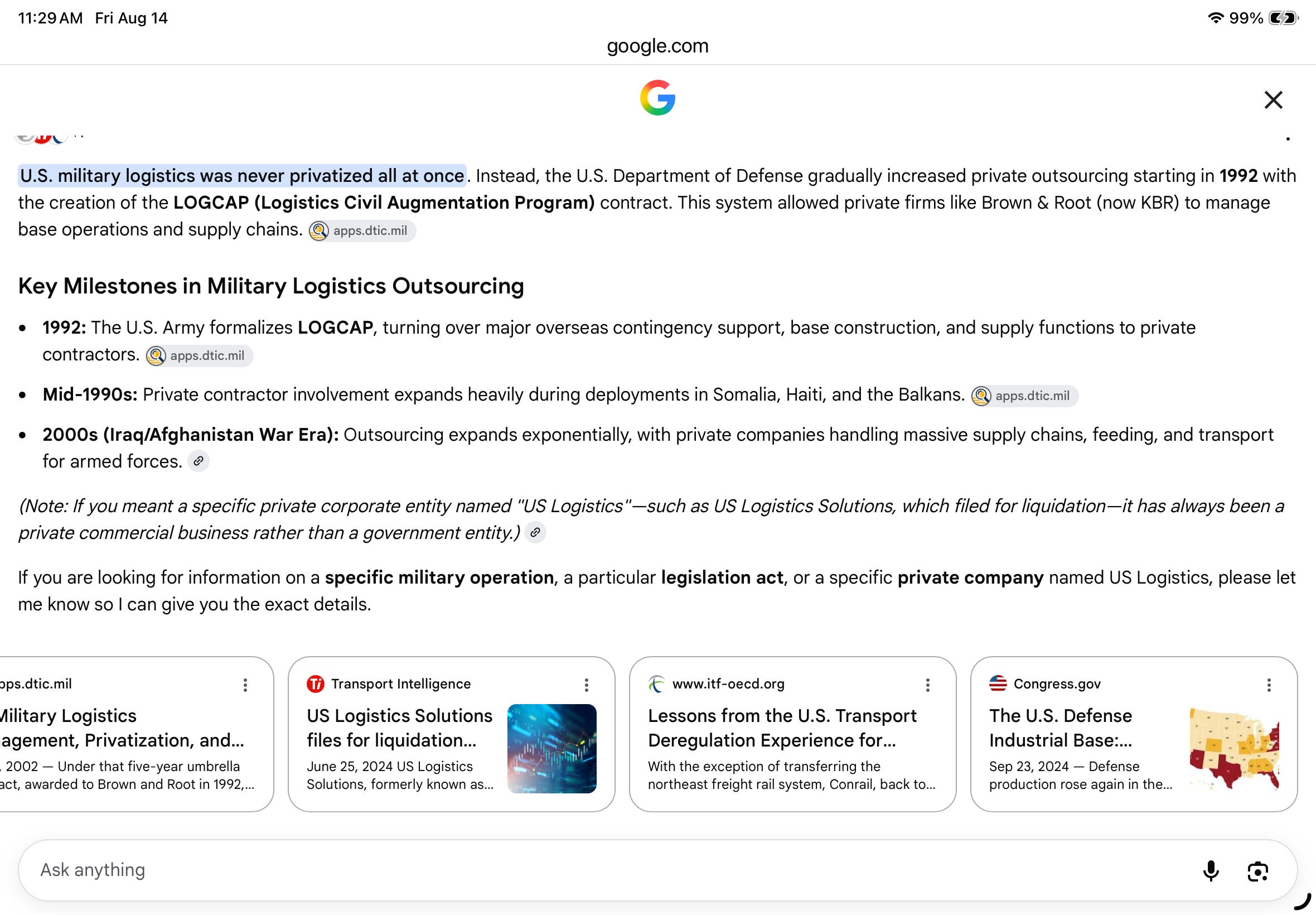
So why is it that the US Navy, for example, was able to produce ice cream in the Pacific theater during the Second World War, but can’t do this anymore? May I suggest privatizing what was a military function? And this started in the 1990s. Incidentally, a certain military site is down for maintenance, which is odd, so I'm using the screen cap from AI, as much as I hate to do that. It’s the relevant site for logistics. I don’t have to wonder why, though.
So here is the thing. After 9/11, we had to spin up to war instantly. So the issues you are hearing about now happened back then too. How do I know? My husband was deployed at the time. He was serving aboard a USN submarine in the western Pacific. And things logistics companies decided they could buy in theater included things like milk and toilet paper. The milk was not that bad of a bet. Let’s just say Saudi Arabia, for example, has a few large cow herds. Toilet paper, though, requires wood pulp. This region isn't known for large tracts of forest. Ok, not within human memory.
Lima Beans and Washing Machines
So how bad did the situation get back then? At some point, the only thing the crew still had that was edible was Lima beans. The cooks were creative with them, but Lima beans do not make for a balanced diet. And to this day, Lima beans have been banished from the household menu.
We got lists of things the crew was desperate for. Because, of course, Navy wives, more than a few on food stamps- that’s the other reality of Navy life- had the money to spare on detergent. And the machines on board require low-sudsing detergent, not Tide. Guess what you could get at the PX? So more than a few washing machines also failed. Those machines are not cheap.
Oh, double-A and triple-A batteries were also sent, because you don’t just need them for Walkmans, but mission-critical flashlights. And yes, the list included candy to deal with cratering morale, and to supplement calories.
The big difference between the present mess and post 9/11 was that sailors had a clear mission. So morale survived contact with this logistics mess better than it has right now. I still don’t know what this war is about. I am sure sailors on the front lines have even less of an idea. I mean, I have time to look up reasons. They don’t.
The other reality is that email was a newfangled thing, especially in the sub service. So all these issues pretty much stayed within the community.
A wider lens
This is not about feeding a single sub crew. That’s just a symptom. It’s not about a carrier crew right now either. It is about the system. The fact we are hearing about this is partially a different culture. But it is also because nobody is happy with this war of choice. But it’s beyond cereal for mid-rats. It's also about expensive systems we've run out of. For example, long-range precision munitions.
We are not officially at war; ergo, as much as Donald Trump wants to, he still can’t really invoke the Defense Production Act. And let’s face it, using a 1.2 million system to bring down a 50 thousand drone makes no economic sense.
So here is the lesson China is learning. The US can’t supply its troops with the basics, let alone replenish ammo stocks. They already knew this about Russia, so now they know. The two Cold War opponents have similar issues.
And in 2006, Donald Rumsfeld resigned after deep congressional losses. Whether then-President George W Bush forced him out, or he was a tad more honorable than I remember, is a good question. But one reason was the infamous logistics issues. Will Pete Heqseth suffer a similar fate? He should. But the real lesson is that we need professionals to bring logistics back in-house. And we need to remember that ice cream is not frivolous. I am sure General Bradley would have views on this mess. I know I do.
The military shouldn’t be rated on just how many troops and guns it has. By that metric, the US does well. But also in how well it can supply milk to a carrier at sea. Doing it for profit means that some people are getting insanely wealthy, and not doing the most basic logistics, implying keeping those bodies fed. Because hungry, malnourished, tired sailors will make mistakes. We are lucky we have not seen anybody killed. It’s a matter of time. I wonder how long before we start hearing of scurvy?
Remembering how incredibly well stored was the Baghram base in Afghanistan ( felt like the biggest mall in San Diego) I am very surprised by the failings logistics of today. Is it the effect of corruption or unpreparedness- after all the war was supposed to last a couple of weekends?
The effect of incompetence?
The effect of profound decline?
„using a 1.2 million system to bring down a 50 thousand drone makes no economic sense“: to a large extent it will depend on what this drone is targeting. If it is, e.g. a nuclear power plant or the bridge of an aircraft carrier then the expense may not appear that disproportionate.